
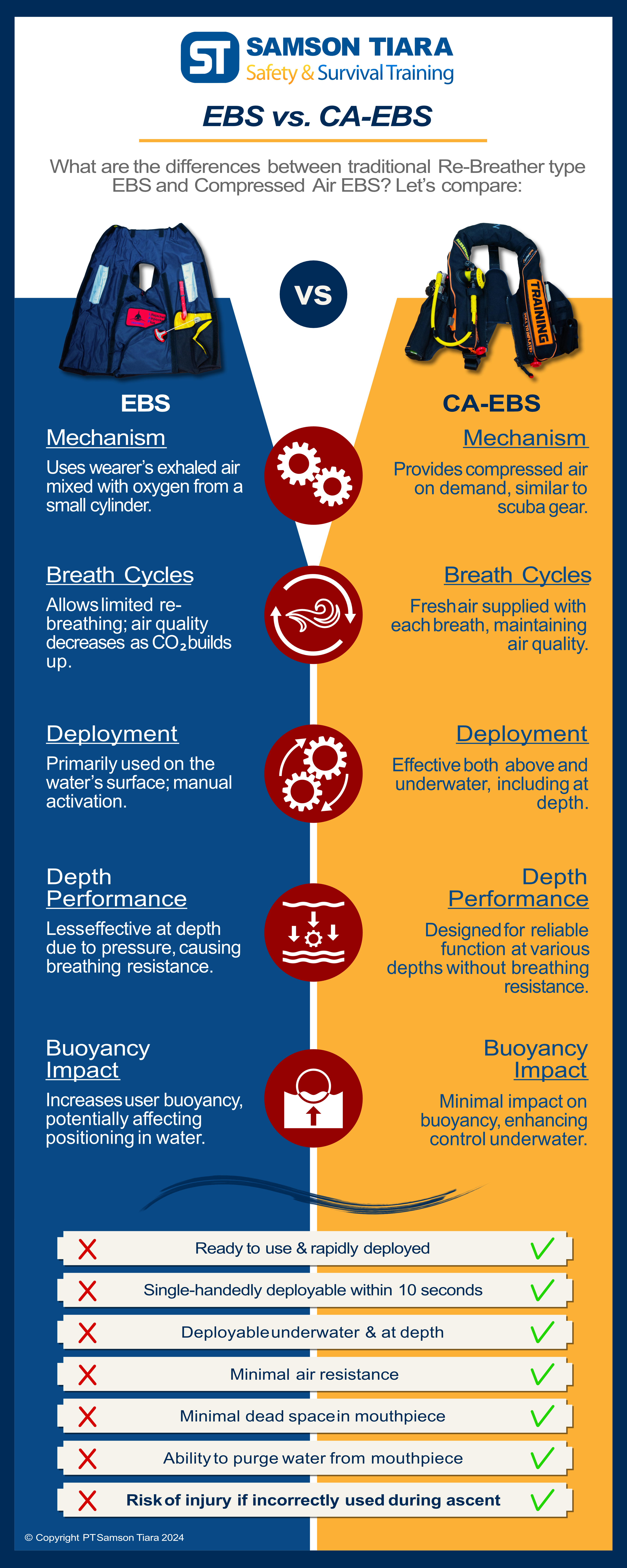
Samson Tiara offers two different types of Emergency Breathing System (EBS):
- EBS
- CA-EBS
So, what are the differences between traditional Re-Breather-type EBS and Compressed Air EBS? Let’s compare.
EBS
- Mechanism: Uses the wearer’s exhaled air mixed with oxygen from a small cylinder.
- Breath Cycles: Allows limited rebreathing; air quality decreases as CO₂ builds up.
- Deployment: Primarily used on the water’s surface; manual activation.
- Depth Performance: Less effective at depth due to pressure, causing breathing resistance.
- Buoyancy Impact: Increases user buoyancy, potentially affecting positioning in water.
CA-EBS
- Mechanism: Provides compressed air on demand, similar to scuba gear.
- Breath Cycles: Fresh air is supplied with each breath, maintaining air quality.
- Deployment: Effective both above and underwater, including at depth.
- Depth Performance: Designed for reliable function at various depths without breathing resistance.
- Buoyancy Impact: Minimal impact on buoyancy, enhancing control underwater.
Other facts about CA-EBS
- Ready to use and rapidly deployed
- Single-handedly deployable within 10 seconds
- Deployable underwater and at depth
- Minimal air resistance
- Minimal dead space in the mouthpiece
- Ability to purge water from the mouthpiece
- Carries the risk of injury if incorrectly used during ascent — training is vital for correct usage
If you want to get experience using EBS and/or CA-EBS, we have the right training for you:
- OPITO CA-EBS: https://ptst.training/wcha5
- OPITO T-HUET with EBS: https://ptst.training/ptr3s